
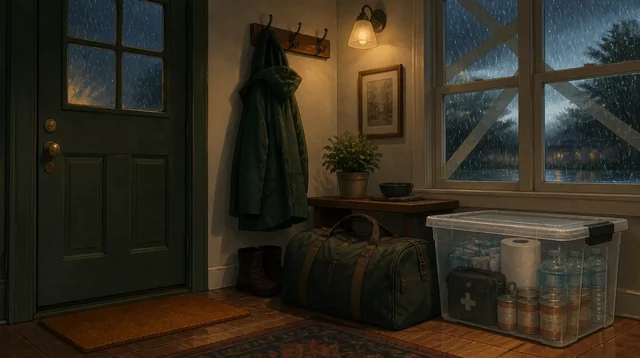
Hurricane Survival Kit: A No-Nonsense Checklist
Published July 30, 2026
The thing that separates a hurricane from most disasters is warning. You usually get days, sometimes a week, which is exactly why the kit should already be built before the season starts and not thrown together while a cone is pointed at you. A good hurricane kit does double duty: it lets you shelter in place if the storm is survivable where you are, and it converts into a go-kit if the order comes to leave.
The core checklist
FEMA's Ready.gov is the sensible source for the quantities here, and none of it is exotic.
| Category | Item | Note |
|---|---|---|
| Water | Roughly one gallon per person per day, several days to two weeks | The single most important line |
| Food | Seven days of non-perishable food, manual can opener | No-cook items reduce your dependence on power |
| Health | First aid kit, a week of any prescription medications | Refill scripts early in the season |
| Documents | IDs, insurance, prescriptions in a waterproof pouch | Photograph them to your phone as backup |
| Cash | Small bills | ATMs and card readers die with the power |
| Power and comms | Hand-crank or battery NOAA weather radio, power banks, chargers | Alerts keep coming when the network strains |
| Light | Flashlights and headlamps, spare batteries | Candles are a fire risk in a stressed house |
| Sanitation | Water for flushing, garbage bags, moist wipes | Overlooked until it is a problem |
| Tools | Wrench or pliers to shut off utilities | Ready.gov specifically calls for this |
Fill the bathtub and any spare containers before landfall for washing and flushing water. That reserve is separate from your drinking supply and costs nothing to stage.
Evacuate or shelter
This is where a hurricane kit differs from a tornado one. A hurricane gives you time to leave, so the kit is also a go-kit. Keep the gas tank full through the season, know your evacuation zone and route ahead of time, and stage pet supplies and a grab bag by the door. The National Hurricane Center is the authority to follow for zone and timing guidance; when local officials call an evacuation, the decision has already been made for you.
If you are staying, the shelter logic looks more like the tornado kit: an interior room, away from windows, on the lowest safe floor given any flood risk. The judgment call is flood versus wind. Storm surge and flooding drive most evacuations, so low-lying homes leave and higher-ground homes often shelter.
Two things separate a calm hurricane from a scramble. The first is timing: build the kit at the start of the season and restock it once, rather than fighting crowded shelves when a storm is already named. The second is people. Infants, elderly family members, anyone on a medication that needs refrigeration, anyone who depends on a powered medical device, and pets all need their own planned supplies, and a powered device needs its battery backup worked out before landfall, not during it.
Round it out
The pieces here overlap heavily with the rest of the emergency cluster, and that is the point. Build once, reuse everywhere. The power outage kit covers the blackout that a hurricane usually brings, non-perishable food goes deep on the pantry side, a packable water filter extends your water past what you can store, and the 72-hour bug-out bag is the evacuation version of all of it. A stored water supply and reliable light are the two things you will reach for first.
More in the Field Journal or start with the season guides.