
What Alone Contestants Actually Wear: The Clothing Rules, Decoded
Published August 15, 2026
The thing most viewers get wrong about Alone is assuming a contestant's coat and boots eat into their gear budget. They do not. Per the show's own rules, each person survives on their 10 chosen items "plus the clothes on their back and production-issued safety and camera gear that doesn't count against the limit." Clothing is separate. That single rule shapes everything about how contestants dress, and it is the key to understanding why they walk in looking like they raided a wool catalog.
The rule, decoded
Two categories sit outside the 10-item count entirely: whatever a contestant is wearing at drop-off, and anything production issues for safety or filming. Neither competes against an axe or a fishing kit for a slot, so people arrive in the heaviest, best cold-weather clothing the location justifies. There is one counterintuitive wrinkle, covered in what clothing doesn't count toward your 10 items: personal-care items like soap, toothpaste, and a razor are treated as selectable gear, not clothing, so they do cost a slot. Almost nobody spends one. Of 101 recorded gear lists, soap appears on just 3, and toothpaste, floss, towel, and razor show zero picks between them. The FAQ states the clothing rule plainly too: ten items, plus standard-issue clothing and safety equipment that does not count toward the ten.
The layering system, head to toe
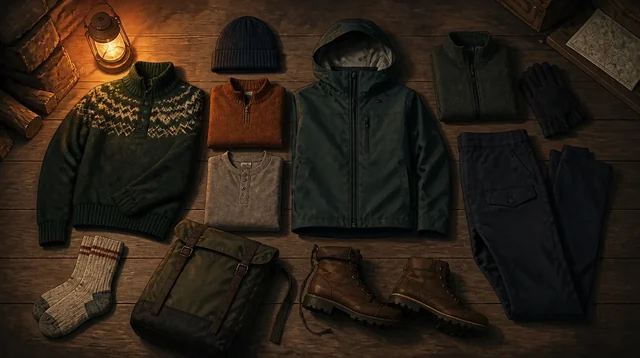
Because clothing is free, contestants build a full cold-weather layering system rather than a compromise. The logic is the same one any experienced cold-weather traveler uses: manage moisture at the skin, trap air in the middle, block wind and rain on the outside, and never let the extremities go.
| Layer | Job | Typical choice |
|---|---|---|
| Base | Move sweat, hold warmth when damp | Merino wool base layer |
| Mid | Trap insulating air | Wool or fleece |
| Insulation | Static warmth in camp | Wool anorak, down or synthetic |
| Shell | Block wind and rain | Waxed cotton or waterproof outer |
| Extremities | Stop heat loss at the edges | Wool socks, hat, gloves, gaiters |
Get a merino base layer and good wool socks right and the rest of the system has something to build on. Get them wrong, in cotton, and no jacket saves you.
The system only works if it is actively managed. The cardinal sin in cold country is sweating: soak the layers from the inside and they lose loft, then freeze, so experienced people shed a layer before hard work and add it back the moment they stop moving. It is also why wool and synthetic insulation beat down for this show. Down is warmer for its weight but collapses into a useless clump when it soaks through, while wool holds a good share of its warmth wet. Footwear follows the same head-to-toe logic, with insulated boots and thick wool socks defending the one place body heat drains fastest, straight down into frozen ground.
Why wool dominates
Wool wins because it keeps insulating when it is wet, resists odor over weeks without washing, and tolerates sparks and heat near a fire better than synthetics. That is why it turns up from the skin outward, especially in cold seasons like the ones that define winter on Alone. The clearest evidence lives in the Alone: Frozen data, where the only clothing records that got sourced are wool: Callie Russell in a WeatherWool anorak and neck gaiter, and Amós Rodriguez in a wool anorak and wool pants. That surfaced because those pieces were sponsor-branded, not because the show tracks garments the way it tracks the 10 items, so treat it as illustration rather than a full wardrobe list. The underlying point holds regardless: whatever a contestant wears lives in a separate bucket from their gear, and in the cold that bucket is almost always wool.
More in the Field Journal or start with the season guides.