
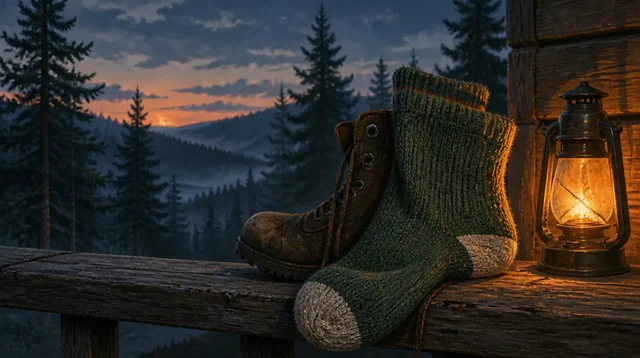
Darn Tough Socks: Why Survivalists Swear by the Lifetime Warranty
Published July 10, 2026
Most gear loyalty is really price-to-performance loyalty, and it fades the moment something cheaper works as well. Darn Tough's following is different, and the reason is a warranty that sounds too good until you read the fine print and find there is almost none. For anyone building a kit meant to last, that changes the whole cost calculation, which is why the brand comes up so often in the same breath as the best merino wool socks for cold and wet.
What the warranty actually says
Darn Tough backs every pair with an unconditional lifetime guarantee. The company's own wording is that if the socks are not the most comfortable, durable, and best-fitting socks you have owned, you can return them. In practice, what people use it for is wear: knit a hole in the heel, and the pair gets replaced free.
The details are what make it unusual. You do not need a receipt, because the brand name is knit into every sock, so the sock is its own proof of purchase. You do not need to register anything. Damage from normal wear, holes, thin threadbare patches, and even socks chewed by a pet or singed at a campfire are covered. As long as enough of the sock survives that they can tell it was once theirs, the claim stands. You mail the worn pair back with a claim form by the cheapest method available, and they issue a credit for the full replacement value. The guarantee follows the sock worldwide, not just within the country you bought it in.
| Warranty question | The answer |
|---|---|
| Cost to file | Free replacement value; you pay only return shipping |
| Receipt needed | No, the brand is knit into the sock |
| Registration needed | No |
| Covers wear holes | Yes |
| Covers pet or campfire damage | Yes |
| Coverage area | Worldwide |
Where the socks come from, and how they are built
Darn Tough knits its socks in Northfield, Vermont, and the domestic manufacturing is central to the brand's identity rather than a marketing footnote. The construction is a merino wool blend, wool for warmth and moisture handling, nylon for the abrasion resistance that pure wool lacks, and a touch of Lycra spandex to keep the sock from sagging into blisters over a long day. That blend is the reason the lifetime guarantee is a workable business model and not a loss leader: the socks are genuinely hard to wear out, so the warranty gets invoked less often than the marketing makes you expect.
The line spans the same cushion range covered in the general sock field guide, from no-cushion liners up to heavily cushioned mountaineering weights, in heights from ankle to over-the-calf. For the cold-and-wet brief, the heavier-cushion crew and boot-height models in the hiking and mountaineering families are the ones to look at. Expect a premium per-pair price band; the warranty is what makes that price reasonable measured over years rather than seasons.
The honest caveat
A lifetime warranty replaces a worn-out sock. It does not make one sock warmer than another, and it does not settle whether wool from a sheep is the right fiber for your foot in the first place. A hard-charging hiker who runs hot might do better on a different weight, or even a different animal's fleece, which the alpaca versus merino comparison lays out in full. And because clothing does not count against a contestant's ten items under the Alone rules, the durability that survivalists prize here is a bonus rather than a slot-saving necessity; you are buying socks you will not have to think about, not socks that earn their keep against an axe. That, more than any single thermal spec, is what the loyalty is really about.
More in the Field Journal or start with the season guides.