
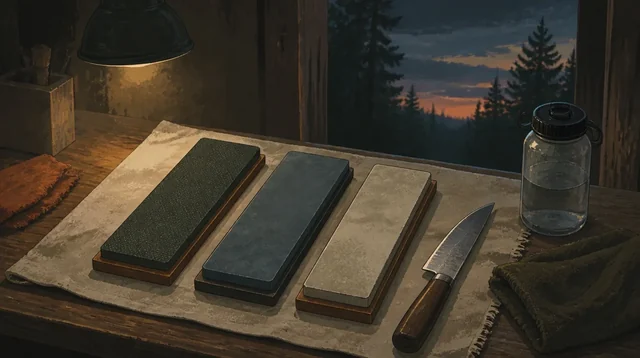
Best Diamond Sharpening Stones: What Actually Cuts Steel
Published July 20, 2026
Diamond stones changed field sharpening for one blunt reason: industrial diamond is harder than any knife steel, so it cuts fast, cuts everything, and does not dish out or wear hollow the way a soft waterstone does. A diamond plate stays dead flat for years, works dry with no soaking or oil, and reprofiles hard modern steels that would glaze a natural stone. For anyone who wants one compact sharpener that handles a season of abuse, it is the honest default. The trade-off is up-front cost and a slightly coarser feel than a fine waterstone at the polishing end, which matters more to a woodworker chasing a mirror edge than to anyone maintaining a working knife.
Read the grit before you buy
The confusing part of diamond stones is grit numbering, because makers do not agree on it. The most reliable way to compare is the micron rating, the actual size of the abrasive particle, where smaller microns mean a finer, more polished edge. DMT, the American brand that effectively set the standard, color-codes its plates so you can read the grit at a glance. These figures come straight from DMT's own published chart.
| DMT grade | Color | Micron | Mesh | Job |
|---|---|---|---|---|
| Extra-Extra Coarse | Silver | 120 | 120 | Heavy repair of badly damaged edges |
| Extra Coarse | Black | 60 | 220 | Aggressive metal removal, axes, tools |
| Coarse | Blue | 45 | 325 | Restore a dull edge quickly |
| Fine | Red | 25 | 600 | Put a sharp working edge on a maintained blade |
| Extra Fine | Green | 9 | 1200 | Polish and refine after coarser grits |
DMT also makes finer plates above this, a 6-micron and a 3-micron tan for a near-polished finish, but for a field knife the coarse-through-extra-fine range covers everything you will actually do.
The brands worth naming
DMT is the reference. Its Dia-Sharp bench plates and Diamond Whetstone line are what most other diamond stones are measured against, and the color system above makes building a two-stone or three-stone progression straightforward.
Sharpal is the strong value pick. Its dual-grit whetstones, the 156N at 6 by 2.5 inches and the larger 162N at 8 by 3 inches, put a coarse 325-grit face (about 45 micron) and an extra-fine 1200-grit face (about 12 micron) on one plate, and ship with an angle guide marked at 14, 17, 20, and 25 degrees, which is a genuinely useful aid for the angle discipline that sharpening lives or dies on. Note that Sharpal calls its fine side 12 micron where DMT rates its 1200-mesh green at 9 micron; that gap is exactly why comparing microns beats comparing grit numbers across brands. Ultra Sharp is the budget end of the category, offering low-cost diamond plates for buyers who want to try the format without a premium outlay, though its grit consistency is less proven than the two names above.
Expect a mid-tier price band for a single quality diamond plate and a bit more for a larger bench stone or a multi-plate set; the value is in longevity, since a diamond plate that stays flat for years outlasts several soft stones.
Where a diamond stone fits
A dual-grit diamond plate is close to the ideal compact sharpener, which is why it comes up so often in the knife sharpening walkthrough. It reprofiles on the coarse side and refines on the fine side, works dry, and packs flat. On Alone, it is worth noting that a dedicated stone of any kind is rare: only 3 of 101 recorded gear lists include one, and one of those three, Zach Gault's, was specifically a two-sided coarse-diamond-and-ceramic stone, the same combination logic these tools follow. That history is covered on the sharpening stone gear page, in what contestants actually use, and in the best-sharpening-stone breakdown. If you carry one sharpener into hard country, a diamond plate is the one most likely to still be flat and cutting when the trip ends.
More in the Field Journal or start with the season guides.